 Nask AI

Key takeaways
- Meta picks the ad for each person, so each ad set is a choice you hand to Meta.
- Ten near-identical ads are, by this guide’s reasoning, close to one real option.
- Variety means a different angle, offer frame or visual, not a new color.
- You approve the direction, Meta picks the winners, Nask AI produces the variations.
How many ads per ad set is the number of distinct creatives Meta can choose between when it decides which ad to show each person; on the reasoning in this guide, the variety between those ads matters more than the count.
You have an ad set ready. Budget set, audience set, pixel firing. The last field is the one nobody agrees on: how many ads go in. A forum thread says a handful. A course gives you a different fixed number. A media buyer on a podcast says as many as you can make, then sells you the tool that makes them.
They are all answering an older question. The number of ads in an ad set is a production decision. What Meta can do with them depends on something else: how different they are from each other. This page replaces the count with a test you can run on your own ads, then shows how to produce ads that pass it when your business sells a call, not a product.
Why the old answer was a number
For years the common advice was a small fixed number of ads per ad set. As media buyers usually explain it, targeting did the heavy lifting. You chose the audience by interest, age and job title, and the ads inside the ad set were a small contest to find the best message for that audience.
On that reading, more ads meant a thinner split. Each ad needed enough impressions to show whether it worked, and an ad set with too many ads could spread delivery so wide that none of them collected enough data to call. So the number stayed small, and testing meant running two or three versions against each other until one won.
The advice also matched how ads were made. A designer and a copywriter could produce a handful of good ads a week for one client. Nobody was asking whether forty ads would help, because nobody could make forty.
Both conditions have shifted, in the way most advertisers describe it. More of the targeting work happens inside Meta’s system, and tools that generate ads made production far cheaper. The number survived anyway, because a number is easier to repeat than a reason.
What changed in how Meta picks an ad?
Meta’s system picks which ad from your ad set each person sees. Meta does not publish the details of how, but public recommendation research points at models that read a person’s recent behavior. Your audience settings are a boundary. Inside it, the choice of creative is Meta’s.
You can see that direction in the research. A team at Meta AI published a paper on research on sequential recommendation at scale that treats recommendation as reading a person’s sequence of actions, and reports the models deployed on surfaces of a platform with billions of users. Alibaba’s team did the same earlier for Taobao in the Behavior Sequence Transformer paper and reported a higher click-through rate online. Neither paper is about your ad set. Both describe the same idea: the system predicts which item fits this person right now from what they did before.
This is also how many advertisers read Meta’s recent delivery changes: broader targeting, more varied creative. A distinction you will hear often is diversification against iteration, where a genuinely new ad is diversification and the same ad with a new call to action is iteration. That reading is usually tied to what Andromeda changed in Meta’s ad retrieval, and it is why the question moved.
On that reading, the question an ad set answers is no longer “which of these three ads is best for this audience”. It is “which of these ads fits this one person”, asked again for every person Meta reaches.
Count against variety: what Meta can use
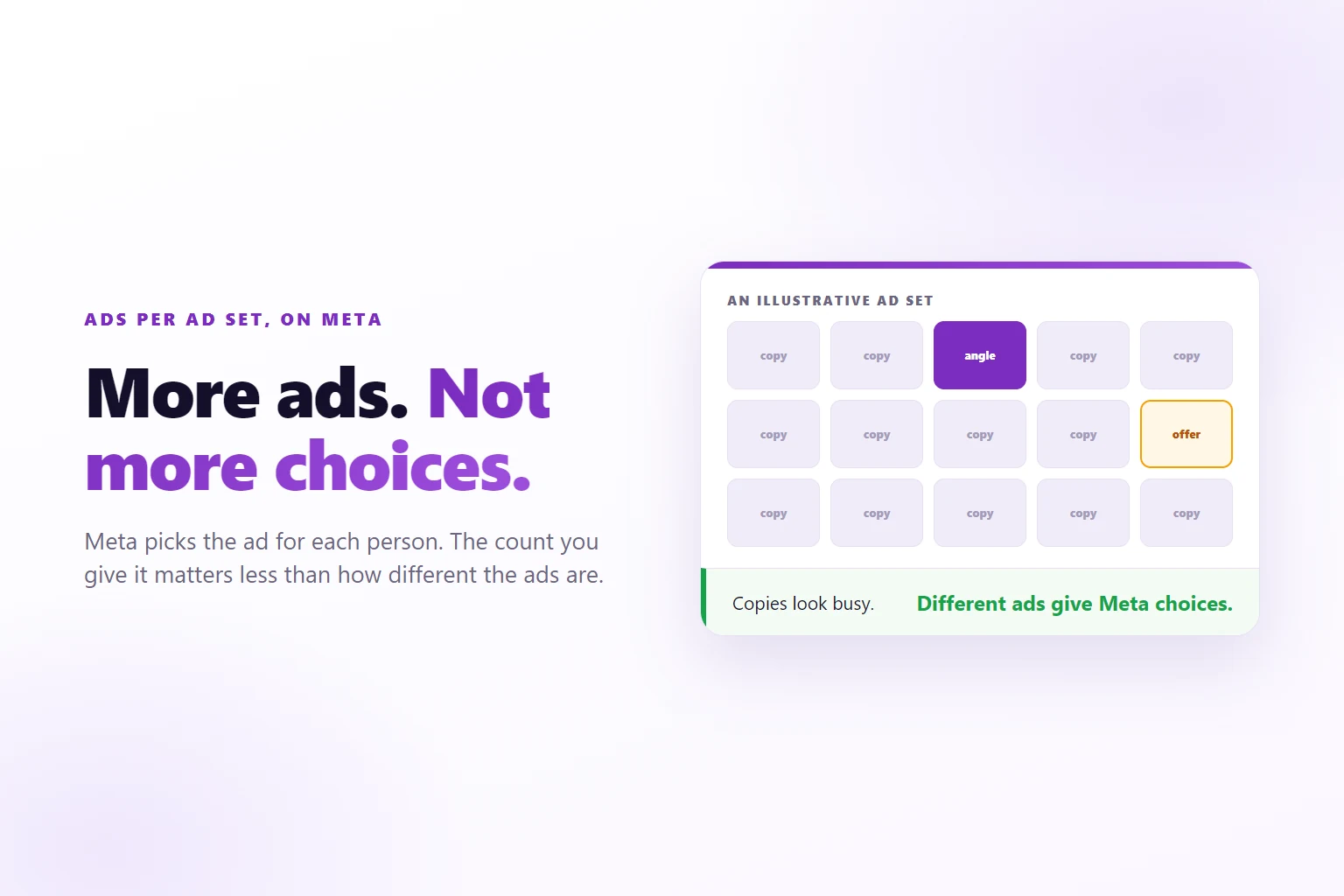
This part is reasoning, not a rule Meta publishes. If Meta matches ads to people, an ad only adds something when it fits someone the other ads do not. Ten ads that make the same point to the same buyer are close to one real option, repeated ten times.
Think of it from the matching side. Meta looks at a viewer and at your ads and predicts which one this person will respond to. If every ad says “book a free strategy call” over a different stock photo, the predictions come out close, because the ads are close. Whichever one Meta picks, the rest add little.
Now put five ads in the same ad set: one about the cost of waiting, one founder story, one built on a client’s result, one that answers “I do not have time for this”, and one that offers a free audit instead of a call. Those ads fit different people. The owner of a three-person firm and the operations manager of a forty-person firm do not respond to the same reason to book. By the same reasoning, Meta now has five real choices.
This is why the count debate never settles. Two people saying “ten ads” mean different things. One has ten different ideas. The other has one idea and nine recolors. The first ad set gives Meta something to match. The second gives it busywork.
Creative was already the bigger lever before any of this. In Nielsen research on creative and sales from 2017, creative is “the undisputed champ” among the drivers of sales lift, even as the share that media drives grew. When the system also uses creative to decide who sees what, the gap between ads matters twice.
What makes two ads different enough?
Two ads are different enough when they would persuade different people, or the same person for a different reason. Four changes pass that test. Most of the others do not.
The angle. The reason to act. Cost of doing nothing, a result someone got, the founder’s story, the objection answered, a mistake the buyer is making. A new angle is a new ad.
The offer frame. What the reader gets for responding. A call, a free audit, a checklist, a short diagnostic. The service behind it can be the same; the first step the reader is asked to take is different, and different people take different first steps.
The buyer. Who the ad speaks to. An owner and an operations manager want different things from the same service. Writing to one of them in the first line changes who stops scrolling.
The visual. Not a new color, a new kind of picture. A face talking to camera, a screenshot of a result, a checklist on a plain background, a photo of the problem. A reader who scrolls past text on a photo may stop for a face.
Changes that do not count: a new button color, the same headline reworded, a different stock photo of the same kind, a new call to action on the same ad. Advertisers who split diversification from iteration file that last one under iteration. Iteration is fine for keeping an ad fresh. It does not give Meta a new person to match.
A working check: lay the ads side by side and, for each one, write who it is for and why they would act, in one line. If two ads get the same line, they are one ad.
How many ads per ad set for a service business?
Enough distinct ads to cover the buyers and reasons you can name, and no more copies than you need to fill the placements. For most service businesses that starts with the few angles you can already defend, each made for the buyers you sell to, and grows only when you find a new angle worth saying.
A service business has a narrower story than a store. You do not have three hundred products to rotate. You have one offer, a few kinds of buyer, and a handful of reasons they book. So the variety comes from those three things crossed with each other: the reason, the buyer, the first step.
The conversion is also different. A store sells on the click. A service business sells a call, and the call sells the service. So an ad that brings cheap leads who never book is a bad ad, whatever its click-through rate says. Judge the variety by booked calls and the sales that follow, not by clicks. Judging creative by lead quality changes which ads you keep, because a cheap lead who never books costs you the call slot and the follow-up.
In Nask AI Studio the count is a field. Each group in the Plan step reads as a sentence: “Make 3 ads for everyone who are any awareness, leading with any angle”, and every word in it is a chip you can change. The default is 3 ads per group. A group takes up to 50, and one run holds up to 10 groups. When you publish, the structure “One ad set per group” makes each group its own Meta ad set, so the group is where you decide how many ads Meta gets to choose from.
When fewer ads is the right call
Fewer ads is right when you do not have more real angles yet. Filling an ad set with recolors to hit a number makes the account look busy and gives Meta nothing.
It is also right in these cases:
- The offer is new and unproven. Three clear angles that you can learn from beat twelve that blur together. Add more once one of them brings booked calls.
- The budget is small. An ad set that spends a little a day gives each ad few impressions. The common rule of thumb: keep a few distinct ads so each gets enough delivery to read, rather than many that are each shown too little to judge.
- You are asking one question. If the test is offer A against offer B, keep everything else the same and run a split test. That is the one case where controlling the ads beats variety.
- The format allows one. When you pick Dynamic Creative, Nask AI warns “Heads up: Dynamic Creative only allows 1 ad per ad set.” With that format the variety lives inside the ad’s assets, not in the ad count.
- Compliance is tight. In a regulated category every ad is a review risk. Ship fewer ads you have read twice.
Fewer is a fine answer when it is a choice. It is a bad answer when it is the only number you were ever told.
How to produce variety without a design team
Write the variety into the brief, then let the tool make the versions. The brief is where angles, buyers and offer frames get decided; production is where they get multiplied.
In Nask AI Studio the steps are Mode, Brief, Plan, Create and Publish. The Brief holds what you sell and to whom. The Plan turns it into groups, one sentence each. The chips in the sentence are the variety: the buyer (“for everyone”), the awareness stage (“who are any awareness”) and the angle (“leading with any angle”), then the style (“styled as”) and the colors. Pick a value and every ad in the group uses it. Set a chip to Surprise and Nask AI picks the value for you.
How Surprise fields vary is a setting called Variety, with three options:
- “Smart: surprised fields random per ad, picks stay fixed”
- “Per ad: re-roll every field per ad”
- “Per group: one roll shared across the group”
For an ad set that should give Meta real choices, fix what you know (the buyer, the offer) and leave the angle on Surprise with Smart or Per ad. To test one angle against another on purpose, make two groups and set the angle in each. A new group can carry its own brief, or you can pick “Add a group: same brief as group 1” to reuse the one you have.
Then you review. In Create, each ad is marked Approved, Needs edit or Rejected. A rejection asks “Why reject it? Pick at least one, or write a note.”, with reasons such as Off brief, Wrong audience and Weak or boring. “Regenerate rejected” re-renders the rejected image ads and leaves the approved ones alone. Videos, uploads and ads rejected only for their copy are skipped, because a new image would not fix them. For a bigger change, “Feedback and Rerun” opens a note right under the finished run. Its “Rerun with feedback” button starts a new campaign with the same setup, hands your note to the planner as revision notes, and lands on Plan for you to generate again. That is how variations from a single brief stay on brand: you approve the direction once and every ad that ships.
Every approved image ad also needs its formats, 1:1, 1.91:1 and 9:16. The Placement coverage panel says it plainly: “Every approved ad needs all formats (or its group marked ‘Let Meta adapt’) before publishing.” A video runs as one cut on every placement, and uploads can be left to Meta to adapt. Ads go to Meta paused by default. When Nask AI creates a new campaign, its settings offer “Status on publish” if you want Active instead; publishing into an existing campaign hides that choice.
If you already have finished ads, Upload & Publish takes them instead. Its “Add ad set” button splits one upload into several ad sets, and each becomes its own Meta ad set, so you can group finished ads by angle the same way. Launching ads in bulk that way skips the generation step and keeps the same structure.
How do you know the variety is working?
A working rule of thumb: variety is working when spend spreads across a few genuinely different ads and cost per booked call holds or falls as you add angles. It is not working when one ad takes everything for weeks and new ads never get shown.
Expect concentration. Media buyers commonly report that a few ads carry most of an ad set’s spend while the rest get a trickle. On the matching reading, that is Meta matching, not failing. The thin ads still matter: each one is a match Meta can make for someone when that person shows up.
What to read, in order:
- Cost per booked call by ad set, then by ad. Leads that never book do not count. This needs the ad identifiers carried from the click to the call, which is what tracking which ad produced a sale is for; the pixel setup guide installs it.
- Where spend goes. As a rule of thumb, three or four ads sharing it is a good sign. One ad on almost all of it for weeks means the others are not different enough to win anyone, or the winner is wearing out.
- Frequency for the same people. If it climbs while cost per lead rises and targeting has not changed, the audience has seen your ideas. That is one of the signs of creative fatigue, and the fix is new angles, not new colors.
- What new ads do. Add a batch of different angles. If Meta starts spending on some of them, they found people the old ads missed. If it ignores all of them, they are probably copies of what is already there.
Do not judge an ad by its share of spend alone. An ad with a small share and a low cost per booked call is doing a job no other ad does. Keep it.
Testing creative without split tests works the same way: put the variety in one ad set, let Meta deliver, and read the results by leads that book, not by which ad got the most impressions.
Frequently Asked Questions
Is there a maximum number of ads per ad set?
Yes. Meta caps the number of ads in one ad set, and the cap has changed over the years, so check Meta’s current figure before you plan a large batch around it. In practice the cap is rarely what limits you. Producing enough genuinely different ads is.
Do more ads split my budget and slow learning?
Not the way a new ad set does. Inside one ad set Meta decides delivery across the ads, and advertisers commonly see spend settle on a few of them. On that reading, near copies waste production more than budget. Ads that are truly different give Meta more people it can match. Watch cost per lead and cost per booked call, not spend per ad.
Should I turn off ads that get no spend?
Not right away. The common reading is that an ad Meta barely spends on is one it expects to do worse for the people it is reaching now, and an ad with little spend costs you little while it waits. Remove it when you need the slot, when it is off-brand or when it is out of date, and replace it with a different angle rather than a recolor.
Do split tests still make sense for creative?
For one question with a clear answer, such as one offer against another, yes. For finding which creative works, a split test cuts against the matching idea: it holds the versions apart so they can be compared, instead of letting Meta match each ad to the people it fits. A common approach is to give Meta the variety in one ad set and judge the results by leads and sales.
How often should I add new ads?
When the numbers say so, not on a calendar. Rising cost per lead with steady targeting, frequency climbing for the same people, or one ad carrying almost all spend for weeks are the usual signals. Add a batch of different angles then, and keep the ads that still bring leads who book calls.
Build your variations in Nask AI
Stop arguing about the number. Write down the buyers you sell to and the reasons they book, and make one ad for each pair that holds up. In Nask AI Studio that is one brief and one plan: you approve the direction, Nask AI makes the ads, and Meta picks which one each person sees. Book a demo and watch it generate variations from one brief.
Nask AI turns one brief into ads that differ where it counts: buyer, angle, offer and visual. You approve every ad before it ships, and it publishes to Meta paused by default, one ad set per group.
Book a demo