 Nask AI

Key takeaways
- Diversification means ads that differ in what they say and to whom, not ads that differ in paint.
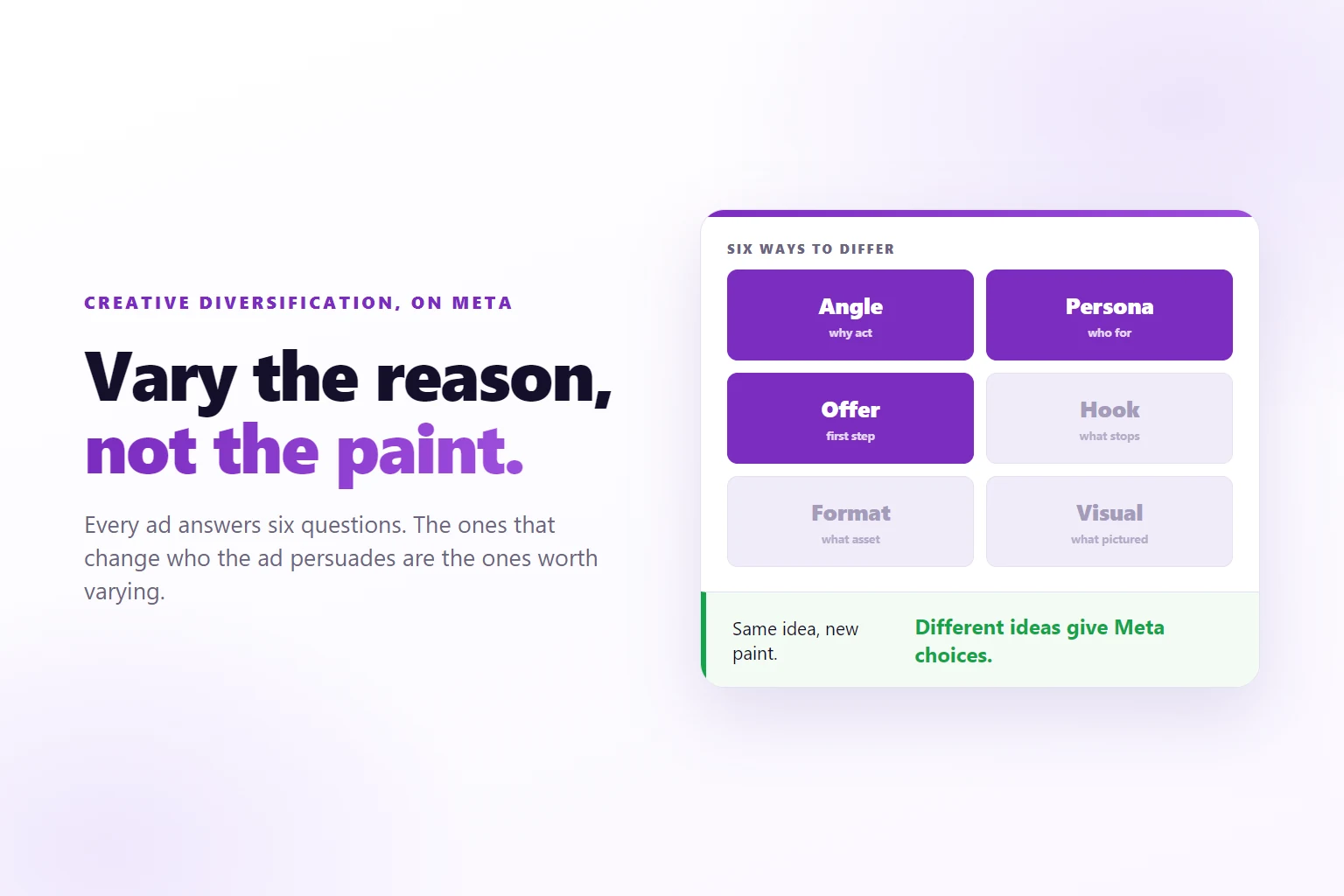
- Every ad answers six questions: angle, persona, offer, hook, format and visual. Vary them on purpose.
- Angle, persona and offer change who an ad persuades. Hook, format and visual change who notices it.
- Cross your buyers with their reasons to book, then keep only the combinations you can defend.
- Name every ad with its combination so you can read booked calls by buyer, reason and offer.
Meta ads creative diversification is the practice of making ads that differ in what they say, to whom and in what form, so each ad gives Meta a different reason to show it to a different person.
Someone told you to diversify your creative. You opened the account and found fourteen ads: one offer, one face, one headline, three background colors. You can feel that is wrong, but the advice stops there. Different how? Different enough for what? And does a new font count?
This page gives you a working method. It names the six ways an ad can differ, tells you which ones carry weight, shows you how to build a map of ads you can defend, and explains how to read the results. It assumes you sell a call, not a product, so the examples are a service business.
What is creative diversification on Meta?
Creative diversification is making ads that are different from each other in ways a person would notice and care about. Different ideas to different buyers, not one idea in fourteen outfits.
The term comes from Meta’s own advice. Jon Loomer, a Meta advertising educator, quotes Meta’s guidance as naming creative diversification the best lever for finding the most relevant audiences. He is also clear that this is not an order to mass-produce. In his write-up of Andromeda, the stage of Meta’s delivery that shortlists ads before ranking them, he calls the change more about capabilities than requirements. Meta’s systems can handle more variety. You are not forced to supply a pile of it.
So the useful reading is narrow. If Meta matches ads to people, an ad adds something only when it fits someone the others do not. This guide is about how to make that happen deliberately. For why the matching works the way it does, read what Andromeda changes for ad creative. For the count question, read how many ads per ad set on Meta.
Diversification against iteration
Diversification adds a new idea. Iteration improves an idea you already have. Both are useful, and only one of them is what the advice means.
A new headline on the same ad, a different button, a fresher photo of the same kind: that is iteration. It keeps a proven ad from going stale and it is cheap. It does not give Meta a new person to match, because the ad still says the same thing to the same buyer.
Diversification is the owner version and the finance-lead version of an ad, or the cost-of-waiting angle next to the second-opinion angle. Loomer lists the differences that count as concepts and angles, formats and personas, and says near-duplicates with small copy or visual tweaks do not. That is a good filter, and the rest of this page extends it.
The test in the scene is the one to use. Put two ads side by side and name the dimensions on which they differ. If you can only name the visual or the wording, you are looking at iteration.
The six dimensions of an ad
Every ad answers six questions. Three of them (angle, persona and format) come from what practitioners such as Loomer list. This guide adds the offer, the hook and the visual as separate dimensions, because a service business varies them differently. Each is defined here, with a service business example: a bookkeeping firm for small agencies.
Angle
The angle is the reason to act. Why should this person respond now? The cost of waiting, a result someone got, the founder’s story, an objection answered, a mistake the buyer is making. For the bookkeeping firm: the cost of waiting against a second opinion before the next renewal, or the reports nobody can read against the bookkeeper who left.
Persona
The persona is who the ad is written for. The owner of an agency and its head of marketing hear the same service differently. The owner thinks about margin and risk. The head of marketing thinks about reports that can be read and a month-end that closes. Writing to one of them in the first line changes who stops.
Offer
The offer is what the person gets for responding, and what you ask them to do first. A call, a written audit, a checklist, a short diagnostic. The service behind it can be identical. The first step is not, and different people take different first steps.
Hook
The hook is whatever a person sees or reads before deciding to stop: the first line of the primary text, the headline, the text on the image, the first seconds of a video. Two ads can make the same point with a question in one and a blunt claim in the other. The hook decides who keeps reading, not who the ad is for.
Format
The format is the kind of asset: a single image, a video, a carousel, text over a plain background. A format change can change who engages, since some people scroll past images and stop for a person talking.
Visual
The visual is what is pictured inside the format. A face to camera, a screenshot of a report, a checklist on a plain background, a photo of the problem. A different kind of picture counts. A different shade of the same picture does not.
Which dimensions do the most work?
Angle, persona and offer do the most work, because they change who the ad persuades. Hook, format and visual change who notices it. This is reasoning, not a published rule from Meta, and it matches the filter above.
Think of it from a buyer’s seat. An owner who is afraid of paying for work nobody checks will respond to a different reason than a finance lead who needs month-end closed on time. No headline fixes that, because the problem is the reason, not the wording. That is the work of the first three dimensions.
The second three decide whether the right person sees the idea at all. A strong angle behind a weak hook is read by nobody. A talking head can reach someone who ignores static images. So use them in service of the idea, one level down.
A working rule of thumb: make the neighbors in your ad set differ on at least two dimensions, and make at least one of those angle, persona or offer. Two ads that differ only in hook and visual are iteration with extra steps. Two that differ in persona and offer are two ideas.
How do you build a diversification map?
You build a map by listing the options on each dimension, crossing the ones that matter, and keeping only the combinations you can defend. It takes an hour with a pen and gives you a plan for a month of ads.
- List your buyers. Two or three kinds of person who actually book a call. For the bookkeeping firm: the owner, the head of marketing, the finance lead.
- List their reasons. Three or four real reasons each might act, taken from calls you have had. For the bookkeeping firm: the cost of waiting, a second opinion, reports nobody can read, someone who left. Not what you wish they cared about.
- List your first steps. A call, a written audit, a checklist. Two is enough.
- Cross them. Three buyers and four reasons make twelve cells. Add two first steps and you have twenty-four.
- Cross out the silly ones. Most combinations will not hold up. A finance lead does not care that the founder’s story is nice. Keep the cells where you can write one sentence for the person and one reason they would act.
- Pick the format and visual last. Once the idea is chosen, decide how it looks and what stops the scroll.
The map is the plan. A thin map, with two buyers and two reasons, is a fine start. Loomer’s own standard approach is the same arithmetic on a smaller scale: he multiplies personas, pain points and proof styles, where one persona with two pain points and two proof styles yields four ads. He says a single persona with one strong message is a good place to begin.
Write the one-line description of each kept cell before you make anything: who it is for, what reason it gives, what it asks them to do. If two cells get the same line, merge them.
Do more ads mean more diversification?
No. This is the obvious answer, and it is the wrong one. A big batch of ads can still be one idea fourteen times.
Loomer reports that he tested 25 and 50 ads per ad set and did not see any clear advantage. He says there is a point where the extra effort delivers no meaningful performance gain. That is one advertiser’s tests, and it is not a law. It does show that the number is not the lever.
A smaller set with real differences beats a larger set of copies on every count that matters: less to produce, less to review, less to read, and more for Meta to match. If you have six ideas, make six ads. If you have two, make two, and spend the time finding the third.
In Nielsen research on creative and sales, creative is “the undisputed champ” among the drivers of sales lift. That finding is from 2017 and about advertising in general, not Meta’s system. It is a reason to spend your effort on the ideas in the ads, not on production volume.
What to keep fixed
Diversify the dimensions, and keep the rest of your brand constant. Your claims must stay true, your offer must stay real and your brand must stay recognizable.
Keep fixed:
- The truth of the claim. Every angle must be something you can back up. A new angle is not permission to promise more.
- The offer’s real terms. If the first step is a call, no ad should imply it is longer, shorter or free of anything.
- The look of the brand. Colors, logo and tone should be recognizable across ads. The visual varies in kind, such as a face against a screenshot, not in identity.
- Compliance. In a regulated category, the wording rules apply to every ad. You can usually still vary the buyer, the situation and the first step inside approved language, and each ad needs a read before it ships.
How do you read the results?
Read booked calls by buyer, by reason and by offer, not only ad by ad. This is where the map pays off.
An ad-by-ad view hides the pattern. If every ad for the finance lead produces calls and every ad for the head of marketing produces none, you learn something about your market, not about one headline. To see that, each ad has to carry its cell in its name. A name such as “Owner / cost of waiting / audit” is enough. Then you can group.
Three things to read, in order:
- Cost per booked call by ad set. Leads that never book do not count. This needs the ad identifiers carried from the click to the call, which is what tracking which ad produced a sale is for. The pixel setup guide installs it.
- Booked calls by group. Group the ads by buyer, then by reason, then by offer. A group that keeps producing calls earns more ads. A group that never does earns a rewrite or a retirement.
- Where spend goes. In practice spend often concentrates on a few ads. That is not failure. A thin ad with a low cost per booked call is doing a job no other ad does.
Wait long enough to read, and judge the ad set in aggregate. One slow day tells you nothing.
When not to diversify
Do not diversify when you have one proven idea you have not yet exhausted, when the offer is new, when tracking is broken or when your budget is too small to read.
- The offer is unproven. Variety multiplies a message. If the message does not work, you get more of what does not work. Fix the offer first.
- Tracking is broken. If you cannot see which ad produced a booked call, you will make a map and learn nothing from it. Fix that before you add ads.
- The budget is small. Each ad needs enough delivery to be read. A few distinct ads read better than many that are each shown a handful of times.
- You have one idea. Making fourteen versions of it is iteration. It is a fine way to keep it fresh, and it is not diversification. Find the second idea.
- You are asking one question. If the question is offer A against offer B, hold everything else the same and run a split test. That is the case where control beats variety.
How does Nask AI Studio produce the dimensions?
Nask AI Studio turns one brief into image ads and copy, and Publish ships only the ads you have approved. The Plan step reads each group as a sentence, “Make 3 ads for everyone who are any awareness, leading with any angle”, and each blank in it is a chip you can change.
Two of the six dimensions are chips. “for everyone” is the persona. “leading with any angle” is the angle. The sentence also carries the awareness stage (“who are any awareness”), the style (“styled as”) and the colors. Pick a value and every ad in the group uses it, or set the chip to Surprise and Nask AI picks.
Two more live in the Brief. Under Copy, “Write Your Own” is captioned “Describe the offer yourself”, which is where the offer goes. Behind “More”, the “Headline format” options, such as Question, Number and Curiosity, rotate the headline structure, and “Primary text” rotates the opening of the body. Both shape the hook. The visual comes from the style you choose. Format is the one you bring yourself: for a video you shot, Upload & Publish takes finished ads.
How Surprise varies is a setting called Variety, with three options: “Smart: surprised fields random per ad, picks stay fixed”, “Per ad: re-roll every field per ad” and “Per group: one roll shared across the group”. For a diversified set, fix what you know, such as the offer, and leave the angle on Surprise.
To compare buyers on purpose, make one group per buyer. Pick “Add a group: same brief as group 1”, then change the persona and the angle. When you publish, pick the Group → ad set structure and each group becomes its own Meta ad set, so each group is one set of ideas Meta chooses between. New campaigns publish to Meta paused by default.
Frequently Asked Questions
Is creative diversification the same as making more ads?
No. Diversification is about how different your ads are, not how many there are. Ten ads that make one point to one buyer are close to one idea. Jon Loomer reports testing 25 and 50 ads per ad set without seeing a clear advantage. A few ads that differ in angle, buyer or offer give Meta more to choose from.
How different does an ad need to be to count as diversified?
It needs to differ on a dimension that changes who it persuades: the angle, the persona or the offer. As a rule of thumb, ads that differ only in wording or in the picture are iteration. Aim for neighbors that differ on at least two dimensions, and use the visual and the hook to make each idea land.
Do I need video to diversify my Meta ads?
No. A set of image ads can still differ in angle, persona, offer and hook, and those are the dimensions that matter most. Format adds one more way to differ when you have a video or another kind of asset ready. Add it when you can make it well, not to hit a count.
Can I diversify when compliance limits what I can say?
Yes, by varying the dimensions your rules leave open. A regulated advertiser often cannot change the claim, but can still change the buyer, the situation described, the first step offered and the visual. Keep every ad inside your approved wording, read each one before it ships, and expect Meta to make the final call on review.
How do I know which dimension is working?
Name each ad with its buyer, reason and offer, then compare booked calls for each group of ads. If ads for one buyer keep producing calls, that buyer is a dimension worth more ads. This needs each booked call tied back to the ad that produced it, since leads that never book would mislead you.
Build your variations in Nask AI
Start with the map: your buyers, their reasons and your first steps. Keep the combinations that hold up and make one ad for each. In Nask AI Studio that is one brief and a group per buyer: you approve the direction, Nask AI makes the ads, and Meta picks which one each person sees. Book a demo and watch it generate the variations from one brief.
Nask AI turns one brief into ads that differ in buyer, angle, offer and visual. Only the ads you approve are published, new campaigns publish to Meta paused by default, and with the Group → ad set structure each group becomes its own ad set.
Book a demo