 Nask AI

Key takeaways
- B2B buyers scroll Facebook and Instagram like everyone else; job-title targeting is the weak part.
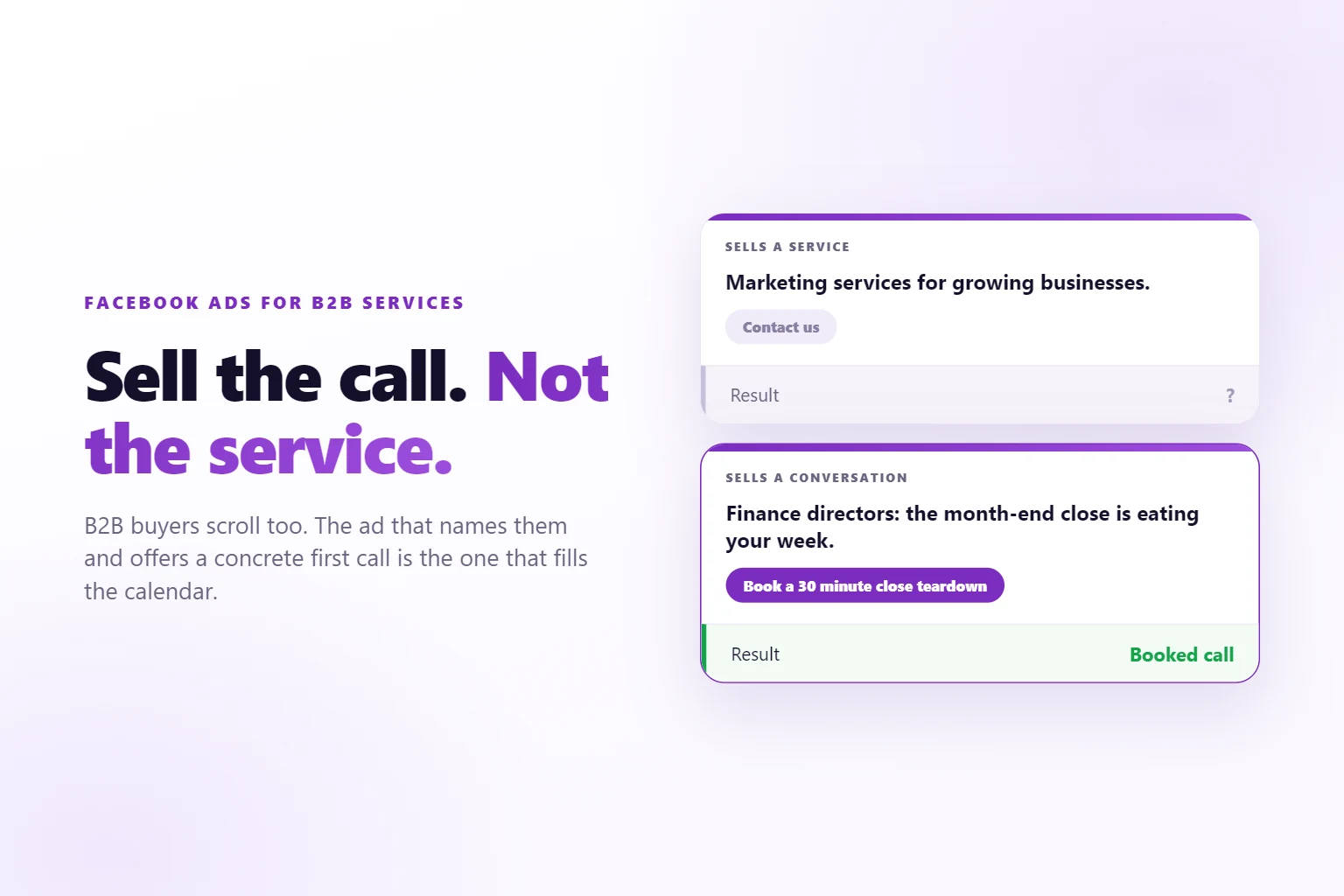
- The offer is a conversation, so the conversion is a booked call.
- Creative does the targeting: the ad names the buyer and the problem.
- Optimize on the booked call and report on the signed client.
Facebook ads for B2B service businesses are Meta campaigns that reach decision makers where they already scroll and sell them a conversation, a call, audit or consultation, rather than a product, measured on booked calls and signed clients.
You sell a service to other businesses: a retainer, a project, an audit. Your buyers are finance directors, operations leads and owners, and someone has told you that Facebook is for holiday photos and that B2B belongs on LinkedIn. You half believe it, because a cold campaign that reaches the wrong people is an expensive way to find out.
So here is the straight answer. Facebook ads can work for a B2B service, and they fail in predictable ways when they do not. This guide covers what the ad should sell, why the creative matters more than the targeting, the funnel behind it, what to send back to Meta, and the cases where you should spend the money somewhere else.
Why B2B services doubt Facebook, and where the doubt is right
The doubt has two sources, and one of them is fair.
The first is a belief about people: that decision makers do not use Facebook. The numbers do not support it. The Pew Research Center’s social media fact sheet, from a 2026 survey, finds that 70% of U.S. adults say they use Facebook and 51% say they use Instagram. Among adults aged 30 to 49, the age of a great many owners and department heads, 78% say they use Facebook. Your buyer is not a different species. They are on the platform in the evening, like everyone else.
The second source is a bad experience, and this one is fair. A B2B service is not a product with a price tag. Nobody clicks a Facebook ad and signs a retainer on the spot. The sale happens on a call, which means the ad has to do something different from an e-commerce ad, and most B2B campaigns fail because they copy an e-commerce playbook: broad awareness, a vague offer, a lead count as the result.
If you ran ads like that and saw a pile of junk leads, the doubt was earned. The platform was not the problem. The ad asked for the wrong thing, and the account measured the wrong number.
There is one more fair objection: the audience is large and the buyers are a thin slice of it. A service for finance directors at mid-size firms is aimed at a small part of the people who see the ad. That is real, and it is why the targeting section below argues for a different tool than the one you expect.
Do Facebook ads work for B2B service businesses?
Yes, under three conditions. Drop any one of them and the answer flips.
- The ad sells a conversation. The thing you are asking for is a booked call, and the ad makes that call worth booking.
- The funnel is tracked past the form. You know which ads produced calls that happened and clients who signed, not only which ads produced a name and an email.
- Meta is taught from those stages. The platform optimizes delivery for the event you send it. Send it a stage that predicts revenue and it looks for more people like the ones who reached it.
Notice what is missing from the list: job titles, lookalike audiences, a clever interest stack. Those are tools. The three conditions are the mechanism.
The honest limit is the deal size. A service that sells for a few hundred dollars a month cannot carry the cost of a long funnel of paid calls. A service that sells for several thousand can. Work out what a signed client is worth to you and what share of booked calls you close before you judge any cost per lead. If you have never measured your close rate, start there, because it sets the budget the rest of this page depends on. The U.S. Small Business Administration’s marketing and sales guidance makes a related point: describe your audience in detail. For a B2B service, the step before buying is a call.
What should a B2B service ad sell?
A call, not a service.
An ad that says “marketing services for growing businesses, contact us” sells nothing. It describes a category the reader already sees fifty times a week, and “contact us” asks for a commitment with no reason attached. An ad that names a person, a problem and a first conversation gives them something to say yes to.
Write the offer as the first call, as consulting firms do with a diagnostic. Three shapes carry most B2B service funnels:
- A teardown. You review something the buyer already has: their ad account, their onboarding, their month-end close. The call is the delivery of that review.
- A diagnostic. You score the buyer on a short checklist and show where the gaps sit. The call walks through the result.
- A plan. You sketch what you would do in the first ninety days, specific to their situation, in exchange for a conversation.
What all three share is a concrete deliverable that exists because of the call. “Free consultation” has no deliverable, so it competes with every other provider on price, which is zero.
The ad itself has a job to do in the first line: name the buyer. “Finance directors at mid-size firms” belongs at the start, because the headline is the only filter you control. Then name the problem in their words, then the offer, then one button. Keep the claim small and true. A B2B buyer reads a lot of inflated promises at work, and a plain statement of what the call covers stands out against them. The same logic applies to coaching ads that book calls, where the wording needs extra care.
Most of the work after that is variety: different problems, different buyers, different first calls. Nask AI Studio takes a brief and produces that variety. Its Plan step is a sentence you edit, “Make N ads for [buyer] who are [awareness stage], leading with [angle]”, where each bracket is a choice with a default of everyone, any awareness and any angle. You narrow the buyer to the one your sales team actually closes, review each ad, and approve the ones that say what you would say on a call. The post on how many ads per ad set on Meta explains why that variety matters more than the count.
Targeting: why the creative does the work
Job-title targeting is the part of B2B advertising that sounds most useful and works worst on Facebook.
Meta can only target what people tell it. A job title or employer shows up in targeting only if the person listed it on their profile, and many never did, or listed it years ago. LinkedIn has the opposite arrangement: people keep their role and company up to date there because it is the point of the site, which is why role targeting is its strength. Facebook was built around something else.
Layer on a second effect. Narrow audiences are small, and a small audience gives Meta little room to find the people who respond. Many advertisers find that a broad audience with a sharp ad holds up against a narrow audience with a vague one. The ad is doing the targeting.
That is the argument against the obvious answer. The obvious move for a B2B service is to stack filters until the audience looks like your ideal client on paper. The better move is to leave the audience wide and make the ad so specific that only your buyer feels addressed.
In Nask AI’s publish step, the ad set has an Advantage+ audience switch. With it on, Meta auto-targets and ignores your manual Age, Gender and Languages settings. For a service whose buyers are spread across a wide age range, leaving it on lets Meta find them. Location is a hard limit either way. Turn it off only when you need a strict age or language limit.
Keep geography. If you only work in one country, or only serve clients in certain regions, set that, because it is a constraint on your business and not a guess about taste.
One boundary applies in regulated services. If you advertise legal services, financial services or health-related services, check the advertising rules that apply to your profession and your regulator before you write the first ad, and do not promise outcomes. That is true on every channel, and it matters more here.
The funnel: lead, booked call, call held, client
A B2B service funnel has four stages, and the cheapest one to measure is the least useful.
- Lead. Someone fills in a form. You have a name and an email.
- Booked call. The lead picks a slot on your calendar.
- Call held. The call actually happens. A no-show is a booked call that never became a conversation.
- Client. The deal is signed and paid.
Each stage loses people, and the loss is where the money hides. A campaign can post an excellent cost per lead while the calls never happen, because the form was easy to fill in and the offer was weak. Another can post a worse cost per lead while it fills the calendar with people who show up. Only a funnel measured to the end tells you which campaign you have.
The numbers in that picture are an illustration, not a benchmark. Your own ratios will differ, and finding them is half the point. Once you know that, say, a share of leads book and a share of booked calls are held, you can work backward from what a client is worth to the most you should pay for a lead.
Two traps catch service businesses at this point. The first is the no-show: if you count the booked call as the win, you will keep ads that book people who never turn up. The second is the lag. A client signs weeks after the click, so an ad that looks weak this week may be the one whose calls convert next month. Read the funnel by the week the lead arrived, not the week the money landed.
For how to follow each lead through all four stages, the guide on tracking leads from Facebook ads to sales goes stage by stage. What happens between the click and the call, from qualifying to routing, is covered in the ad-to-pipeline path for B2B leads.
Instant form or landing page for B2B?
An instant form keeps the lead inside Facebook or Instagram and gives you a name and an email; a landing page on your own site asks for more effort and tells you more about the lead. For a B2B service sold on a call, run both against the same offer and judge them on cost per booked call, not cost per lead.
What to track and send back to Meta
Tracking is what separates a B2B service campaign that improves from one that drifts.
Meta optimizes delivery for the event you send it. If the only event is the form, Meta gets good at finding people who fill in forms. If the event is a booked call, it looks for people who book calls. A held call or a signed client is better still, but only if it happens often enough for Meta to learn from. A stage that fires a handful of times a week gives it little to work with, which is why many service businesses optimize for the booked call and report on the client.
In Nask AI, you map those stages in the pixel’s funnel setup. nsk.js, the Nask AI pixel, catches the form and the booking on your pages, and the stages that happen elsewhere, such as the call held in your CRM or the payment in Stripe, come in from the server. Each stage has a Send to Meta switch, so you choose which ones Meta sees, and each one can carry a Value, because a booked call is worth something before anyone pays. The Nask AI pixel setup guide walks through the install, the stage map and the test.
Test every stage yourself with an email address you own before you spend on it. A booked-call stage breaks easily, because booking widgets run in a frame from another domain and a script on your page cannot see inside it. In Nask AI each stage has a Test this stage button for exactly this reason. Skip the test and you are guessing.
One more thing belongs in this section. The identifiers that tie a stage to an ad are personal data. If your visitors are in a region with data protection rules, say in your privacy notice what you collect and where it goes, and ask for consent where the law requires it.
When Facebook is the wrong channel
Facebook is not the answer to every B2B service, and a few cases are clear.
- Your buyer is a small, named list. If you sell to the hundred companies in your niche and you know who they are, outreach to those hundred will beat any ad. Paid media pays when the audience is too big to name.
- The deal is too small for a paid funnel. If a signed client brings in less than the cost of the calls it takes to land one, the arithmetic fails before the ads do. Fix the price or the close rate first.
- You cannot take the calls. An ad that works will book calls, and a calendar nobody staffs turns that into wasted spend and annoyed leads.
- You have no way to follow a lead to a client. Without tracking past the form, you will optimize for form fills and learn nothing about what pays. Build the tracking before the campaign, not after.
- Your buyers are only reachable by role. If the whole value of your targeting is “VP of procurement at companies with 5,000 staff”, LinkedIn was built for that, so compare it on cost per booked call before you commit the budget to Facebook.
- Your sales cycle is longer than your patience. If a deal takes six months to close, a campaign needs a runway that long before cost per client means anything.
None of these is a verdict on Facebook. Each is a check you can run before you spend a dollar.
Frequently Asked Questions
Can I target by job title on Facebook?
Only loosely. Job title and employer targeting depend on what people list in their profiles, which is often missing or out of date, and many advertisers find broad audiences hold up against narrow ones. So most B2B service advertisers target broadly and let the ad name the buyer: the right people stop, and everyone else scrolls past.
Is LinkedIn better than Facebook for B2B services?
“Not by default: LinkedIn targets by role more precisely, Facebook usually reaches the same buyers for less, so compare cost per booked call. LinkedIn lets you target by role and company because members list them on their profiles, which makes the audience narrower. For services sold on a call, compare cost per booked call and cost per client across both, not cost per click.
What offer works best in B2B service ads?
One that makes the first conversation worth having: a specific audit, teardown, plan or diagnostic tied to a problem the buyer already knows they have. Generic offers such as a free consultation compete with every other provider. The more concrete the deliverable of the first call, the better the booking rate tends to be.
How long do B2B service ads take to work?
Expect the first weeks to produce signal, not profit. Tracking and a few rounds of creative come first; booked calls show whether the offer lands; closed clients take as long as your sales cycle. Judge the early weeks on cost per booked call, and give the campaign at least one full sales cycle before judging cost per client.
Should B2B service businesses run on Instagram too?
Usually yes, because one Meta campaign can place ads across Facebook and Instagram and shift spend toward what works for your goal. Decision makers use both. Make sure the creative works in vertical formats, since many Instagram placements are vertical, and judge placements by booked calls rather than by clicks.
Launch B2B service ads with Nask AI
Nask AI covers the loop this page describes. Nask AI Studio turns one brief into ads that each name a buyer and a problem, you review and approve them, and Upload & Publish sends them to your ad account. The pixel on your own site then follows each lead to the booked call and the client, and sends the stages you choose back to Meta.
Bring one offer and one buyer. Book a demo and watch Nask AI turn them into ads, then follow the first lead to a booked call.
Book a demo