 Nask AI

Key takeaways
- A coaching ad sells the call, and says plainly what the call is.
- Describe the program and who it is for. Do not tell the reader what is wrong with them.
- Any promise about your clients’ results needs records behind it before the ad runs.
- An application form sorts the curious from the ready before the calendar opens.
- Track the booked call as its own stage, and tell Meta about it.
Facebook ads for coaches are Meta campaigns that sell a booked call rather than a program, with wording that describes the offer instead of the reader, and tracking that follows each lead to the call and the enrollment.
You coach for a living, and the program is sold on a call. Someone applies, you talk, and the ones who fit enroll. You tried Facebook ads, and Ads Manager reported leads. Your calendar reported a few calls, half of them from people who were never going to pay, and a good week looked the same as a bad one.
Coaching has three problems that other services do not. The offer is the person, the wording sits close to Meta’s rules, and the booking funnel is full of curiosity. This guide takes them in that order.
Do Facebook ads work for coaches who sell on a call?
Yes, under three conditions. The ad sells a specific call. The wording describes the program and promises nothing you cannot document. The funnel is tracked to the booked call, so Meta learns from calls and not from form fills.
The limit is arithmetic. Work out what an enrolled client is worth and what share of held calls enroll before you judge any cost per lead. A program priced like a book is sold on a page with a checkout, not on a call, and ads for it follow a different logic. Consultants who sell a diagnostic first face a similar problem, covered in Facebook ads for consulting firms.
What should a coaching ad sell?
The call, and the ad should say what the call is. A coaching call is usually a sales call, and pretending it is free advice attracts people who feel tricked when it ends in an offer. Name the outcome of the call instead: you will know where you are stuck, what the next step is and whether the program fits. The same call-first logic applies to B2B service businesses that sell on a call.
Coaching calls usually take one of three forms:
- A strategy session. One call with a concrete takeaway, such as a written next step.
- A workshop. A live or recorded training that earns the application, with the call for the people who want more.
- A short assessment. Questions the buyer answers about their situation, ending in a call booked to go through the result.
All three give the buyer something to say yes to. “Book a free call” gives them nothing, which is why it blends into every other coach.
Which angles suit coaching?
An angle is the reason to act now. Coaching angles work when they anchor on a situation, not on an identity: a decision coming up, a method with a name, a mistake that repeats, a story of one client’s path.
Five angles beat five rewordings of one angle. Variety gives Meta more to choose from, and a coach has more raw material than they use: the questions asked on every first call, the three mistakes seen in every intake, the moment clients usually decide. The post on how many ads per ad set on Meta explains why variety matters more than the count.
In Nask AI Studio, the Plan step is one sentence you edit, and the audience, awareness and angle are chips in it. Point the angle chip at one situation per group, review every ad, and approve the ones that say what you would say on a call.
Here is an illustrative angle set for one niche, a coach who works with first-time managers. The examples are made up to show the spread, not results from any account:
- A situation. The first team meeting after a promotion, and what to say in it.
- A named method. The way you run a first one-on-one, with a name the buyer can repeat.
- A repeated mistake. The thing new managers do in their first month that costs them the team’s trust.
- A client path. One anonymized story of where a manager started and what the coaching changed, with no promised outcome.
- A first-call question. The question you ask every new client in the first five minutes, and why.
Each angle is a different reason to stop scrolling, and each ends in the same offer: a call that tells the buyer where they stand.
Where do coaching ads run into Meta’s personal attributes rule?
When the ad talks about the reader instead of the program. Meta’s advertising standards say that an ad should not assert or imply that the viewer has a personal attribute, and the examples include health, mental health and vulnerable financial status. Those are the daily topics for health, life and money coaches. Wording and enforcement change, so read the current standards in your own account before you write.
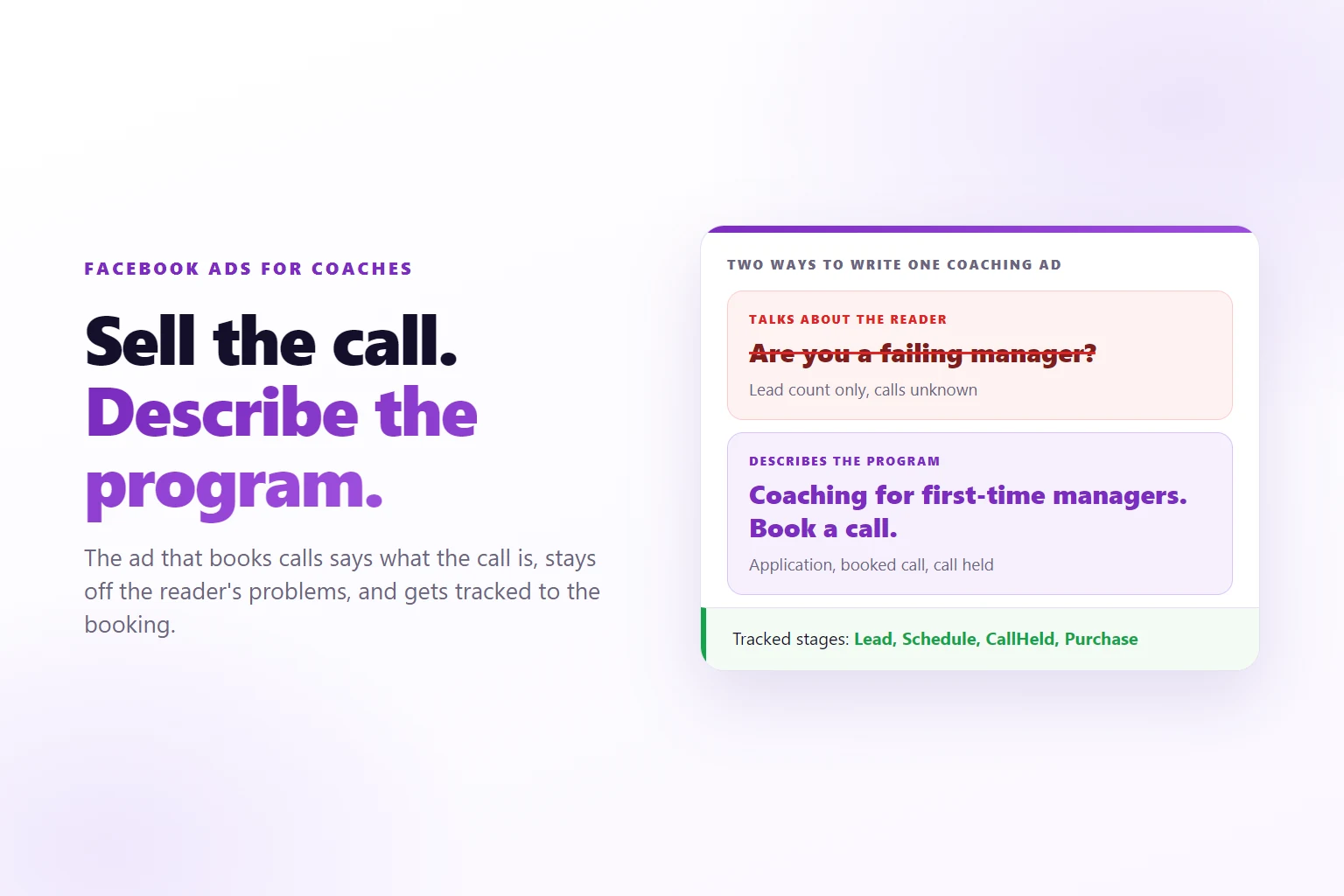
The pattern is the same each time: a question that diagnoses the reader becomes a line that describes the offer. “Are you a failing manager?” becomes “Coaching for first-time managers.” “You are drowning in debt.” becomes “A budgeting session for freelancers.” “Tired of your anxiety?” becomes “A coaching program for people in high-pressure jobs.”
The manager example is about tone, not a listed attribute: it still tells the reader something is wrong with them, which is the habit to drop. No rewrite is certified. Meta decides, reviewers vary, and an ad that passes today can be flagged next month. Nask AI helps you produce the variety and you approve each ad, but it does not promise approval. Plan for some rejections and keep other angles running.
How do you write results and income claims for coaching ads?
Say what the program does, and keep any claim about your clients’ results to what you can document. Two parts of the U.S. rules matter most.
The first is testimonials. The FTC’s Endorsement Guides, in 16 CFR 255.2, say an advertiser must possess and rely on adequate substantiation for claims made through endorsements, and that consumer endorsements are not evidence by themselves. If you cannot show an endorser’s result is what people generally get, the guide says the ad should clearly disclose the generally expected result. Its savings example says “Results not typical” is not enough to prevent a deceptive ad.
The second is income. 16 CFR 437.1 defines an earnings claim as any representation that conveys, expressly or by implication, a specific level or range of actual or potential sales, income or profits. The Business Opportunity Rule it belongs to bars misrepresenting earnings and requires written substantiation for earnings claims, and its definition of a business opportunity is about sellers who provide locations, customers or a buy-back. In January 2025 the FTC proposed extending the rule to business coaching and investment opportunities. Whether it covers your program is a question for a lawyer, and the proposal’s status is worth checking.
The practical line is the ladder above. “Coaching for first-time managers” needs only to be true. “Clients got promoted” needs records and the typical outcome. “You will earn six figures” is the claim that draws the rule, so leave it out of the ad.
What should the booking funnel look like?
The job of a coaching funnel is to keep the promise of the ad alive through every step. A buyer who clicked an ad about the first team meeting after a promotion should land on a page that opens with that situation, meet an application that asks about it, and read a confirmation that says the call will cover it. Each step that drops the thread, such as a generic “Welcome to my coaching” page, hands the buyer a reason to leave.
The call should pick the thread up too. Open it by repeating what the buyer said in the application, in their words, and the call feels like a continuation and not a sales script. Tag each ad with its angle in the link, for example in the utm_content parameter, which nsk.js stores with the visit, and every enrollment points back to the angle that produced it.
The gap between the booking and the call is where coaching funnels leak. A booking made on Tuesday for the following week gives the buyer days to cool off. Close it with three small steps: a confirmation page that says what the call covers and what to have ready, a reminder the day before and again an hour before, and one question in the confirmation, such as the single thing they want settled on the call. A buyer who has answered that question has already started the conversation, and you walk into the call knowing where to start. Then mark the outcome the same day, because the call held is a stage of its own.
Application form or open calendar?
Use the application when the calendar fills with people who are not a fit, and the open calendar when you can take every call. The open calendar gives more bookings and more no-fits. The application adds a step, so fewer people finish it, and the ones who do have told you what they want, when they want to start and whether the budget exists.
Keep it to three or four questions, and make each one earn its place. Ask what they want help with in their own words, which tells you the situation and gives your first call its opening. Ask when they want to start, which separates a plan from a daydream. Ask about budget as a range they can pick from, which spares you a call about a program they cannot afford. Ask whether they can commit the time each week, because a program nobody attends does not produce the result you advertise.
The pixel stores the fields of your application form in Nask AI, except password fields and fields named like card or ID numbers, but they are not sent to Meta. Meta gets the stage, its value, hashed contact details, the page address and browser identifiers such as IP address and user agent. Leave sensitive questions out of the form. Send a not-a-fit to a thank-you page with something useful and no booking link. Then compare the two versions on one number: the share of held calls that end in an enrollment.
How do you track the booked call?
Put the application on a page you control and catch the calendar booking with a stage of its own. The calendar is the one part of your funnel you do not control. It is a frame served by the scheduling tool, so a booking can finish without your page noticing. Calendly documents postMessage events and Cal.com documents embed events, and a page can listen for them.
nsk.js, the Nask AI pixel, listens for that message from Cal.com, Calendly and GoHighLevel. In the funnel setup that detection is called Booking or form widget. The application is a Form on a page. Ask for the email in the application and use the same one in the calendar, because the email is what ties a later stage to the same person. Then test: click Test this stage, book a real slot with an email address you own, and watch it arrive. The guide to tracking leads from Facebook ads to sales goes stage by stage, and the Nask AI pixel setup guide covers the test panel.
Which stage should Meta optimize for?
Start with the booked call. Meta optimizes for the event you send it, so pick a stage that fires often enough to learn from. Enrollments can be few for a program priced for a small number of clients, and booked calls fire more often while still pointing at revenue.
In Nask AI each stage has a Send to Meta switch and a Value field, so you choose what Meta sees and what a booked call is worth before anyone pays. The call held happens off your site, so it arrives from the server: a webhook (Make or Zapier can send it from most CRMs), or an Attio stage, which the Nask AI team sets up for you. Report on both, and move the optimization down the funnel when a deeper stage fires steadily.
For a coaching funnel that makes three stages to care about, in the order they happen:
- Booked. The Schedule stage, caught on your page when the calendar widget reports a finished booking.
- Showed. The call held. It is a custom stage, which you name CallHeld and map with Counts in reports as. A webhook sets it when someone marks the call as done, which is how a no-show stays a booking and never becomes a held call.
- Enrolled. The Purchase stage, from a Stripe payment or from Make or Zapier through a webhook. Purchase is not sent to Meta unless it has a Value, so set one that matches the program’s price.
Compare booked to showed first. A wide gap means the problem sits between the booking and the call, so fix the follow-up before you touch the ads. A narrow gap with few enrollments means the problem is the call itself, and a better ad cannot repair it.
When Facebook ads are the wrong move for a coach
Check these before you spend:
- Your price is low. A program sold for the price of a book belongs on a checkout page, not behind a call.
- You cannot take the calls. Count the calls you can hold in a week. An ad that works fills the calendar, and an unstaffed calendar wastes the spend and the leads.
- Your buyers are already in your network. If the people who hire you come from referrals and a list you can write to, start there and add ads when the list runs dry.
- You have no way to follow a lead to an enrollment. Without tracking, you keep the ad that books the most, not the ad that pays.
- You have no proof you can show. If the only thing the ad can say is a result you cannot document, fix the offer first.
- You cannot yet run the call. If your call has no structure and ends without an offer, ads will only pay for more of it.
Frequently Asked Questions
Can a coach run Facebook ads without a big following?
Yes, because ads reach people who have never heard of you. A following helps with trust, but it is not what fills a calendar. The offer, the wording of the ad, the path to the booking and the tracking matter more. Start with one clear offer and one buyer, and let the booked calls show whether the ad is working.
Can I show client results in a coaching ad?
Yes, but only results you can back with records, and read the FTC’s endorsement guide before you do. It says a consumer endorsement is not evidence by itself, and if you cannot show the result is representative you should disclose what is generally expected. Its own savings example says a results-not-typical line does not fix a misleading ad.
Should the ad send people to an application or straight to my calendar?
Send them to an application when your calendar fills with people who are not a fit, and straight to the calendar when you can take every call. An application adds a step, so you get fewer bookings and better ones. Test both against the same offer and compare the share of calls that end in an enrollment.
What should I optimize a coaching campaign for?
Start with the booked call. Enrollments can be too few each week for Meta to learn from, while booked calls arrive more often and still predict revenue. Report on the call held and the enrollment, and move the optimization down the funnel only when a deeper stage fires steadily.
What do I do when Meta rejects a coaching ad?
Read the reason shown on the ad, change the line it points at, and submit a new version. Ask for a review only when you believe the ad follows the rules. Rejections can trace back to wording that talks about the viewer’s condition or promises a result, so check those two things first.
Launch coaching ads with Nask AI
Nask AI Studio turns one brief into ads that describe your program and name a situation, you review and approve each one, and the publisher sends them to your ad account; new campaigns publish to Meta paused by default. The pixel on your own site then follows each lead from the application to the booked call, and sends the stages you choose back to Meta.
Bring one coaching offer. Book a demo and watch Nask AI turn it into ads, then map the funnel from the application to the booked call.
Book a demo