 Nask AI
Key takeaways
- A consulting ad buys one thing: a first conversation with the right person. The sale happens after it.
- The first step should end with something the buyer keeps: a diagnostic, an audit or a briefing.
- Proof works without a client name: describe the client, show the shape of the work, skip numbers you cannot back up.
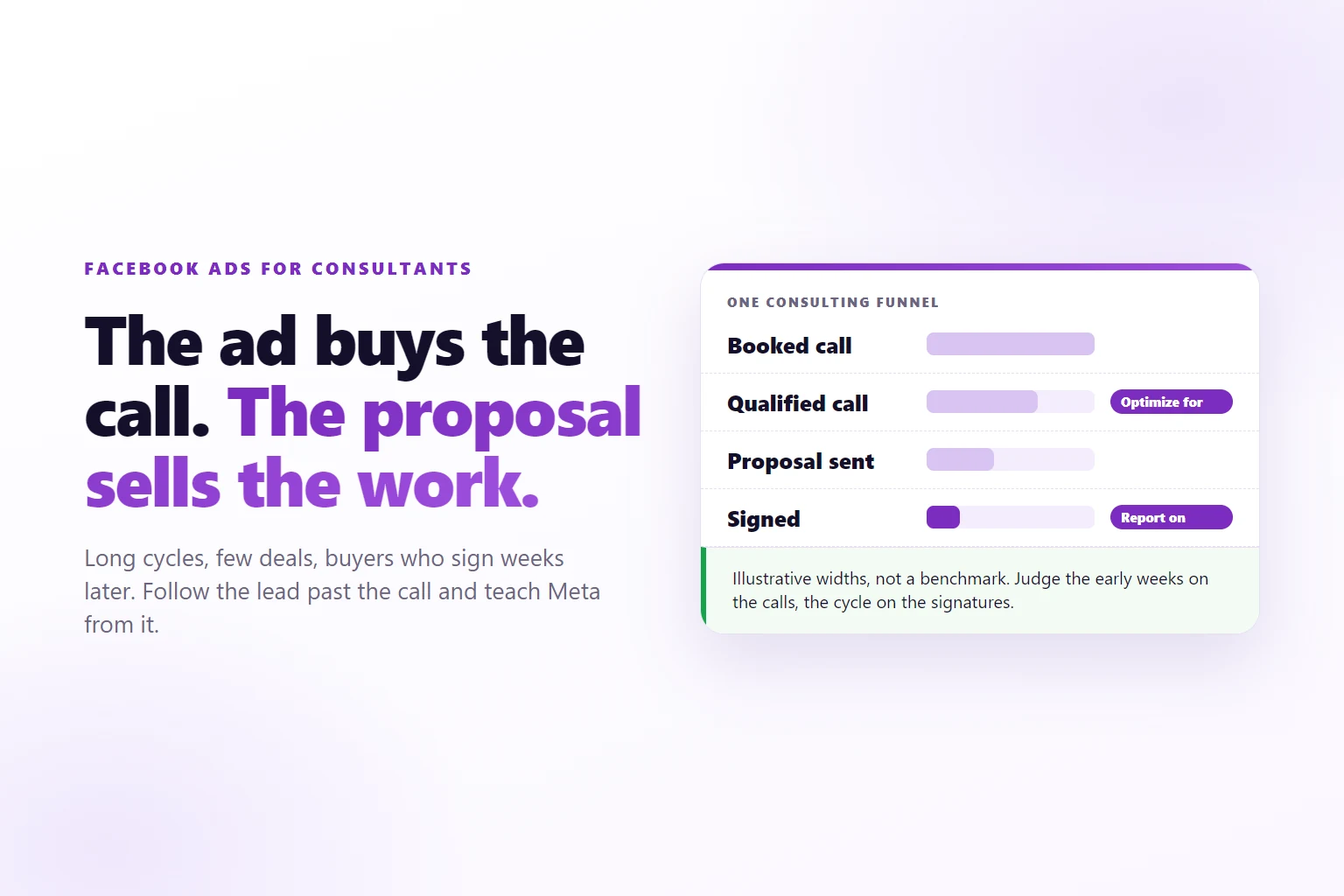
- Track past the call to the proposal and the signature, and optimize on the deepest stage that still happens often.
- Read results by the week the lead arrived, and wait a full sales cycle before judging signed clients.
Facebook ads for consultants are Meta campaigns that sell a scoped first step, a diagnostic, audit or briefing, to buyers who hire advisers on long cycles, tracked from booked call to proposal to signed engagement.
You advise companies for a living, and one signed engagement is worth enough to pay for months of ads. That part is good. The part you already know is the bad one: nobody signs a consulting engagement from an ad. A buyer reads a proposal, asks two colleagues, waits for a budget conversation and signs weeks or months after the click. Meanwhile Ads Manager reports leads, and a fair share of them are students, job seekers and vendors who want to sell to you.
So Facebook ads for consultants are a different problem from ads for a product. The ad closes nothing. It buys a first conversation with the right person, and the funnel behind it has to be followed long enough to learn whether that conversation was worth buying. This guide covers who the ad speaks for, what to offer first, how to show proof without naming a client, how to keep in front of buyers who are not ready, and what to send back to Meta when you sign a few engagements a month.
Solo consultant or firm: who does the ad speak for?
A solo consultant sells judgment, so the ad can carry your name and face, and the person who clicked is the person who will sit across from you. The buyer is deciding whether to hire you, and a real person in the first second beats a logo. The limit is your calendar. An ad that works fills it, and a call you cannot take is spend wasted on someone who then waits. Decide how many calls a week you will hold before the campaign starts, and pause when the calendar is full.
A firm has the opposite problem. “We help companies transform” names no buyer and no problem, so nobody stops. Split by practice line: one buyer and one offer per campaign, such as operations for mid-size manufacturers or finance reporting for private-equity-backed companies. Each practice line gets its own ad, its own booking link and its own person on the call, which also tells you which practice line a booked call, a proposal and a signature belong to. If the ad shows a partner and an associate takes the call, the buyer notices in the first minute.
In Nask AI the split maps onto briefs. Nask AI Studio turns a brief into ads, and one brief per practice line keeps each set of ads aimed at a single buyer. The post on how many ads per ad set on Meta covers how many ads each ad set needs.
What should a consultant offer first?
Something you can deliver inside the call or within a few days, and that points at the paid engagement. The first step shows your method on a small piece of the buyer’s own business, and it ends in a decision about what comes next. Three shapes fit a consultancy, each tied to a thing an adviser can really produce.
- Diagnostic. It scores one area of the buyer’s business and shows where the gaps are, such as a manufacturer’s order-to-delivery process. The buyer leaves with a scored read of one process.
- Audit. It is a written review of something the buyer already has, such as a reporting pack or a vendor contract set. The buyer leaves with a short written report in days.
- Briefing. It is a prepared session on one decision the buyer faces, such as entering a new market. The buyer leaves with the options for one decision laid out.
Scope is the discipline here: past a few days of work, a first step turns into unpaid project work. A diagnostic that scores a process and shows three gaps makes the proposal a natural next step. A briefing that ends with “so, what are you thinking?” does not.
Name the buyer and the problem in the first line, then the first step, then one button. An illustrative example: “Operations directors at mid-size manufacturers: your last three projects ran over and nobody can say why. Book a 45 minute diagnostic and see where the margin went.” That line screens in operations directors and promises a defined output.
How do you show proof without naming clients?
Most consultants cannot name clients, and the ad does not need names. It needs the reader to believe you have done this for people like them. Four things carry that without breaking confidentiality.
- A descriptor. “Mid-size manufacturer” tells a similar buyer more than a logo would, if the description is specific enough for them to recognize their own situation.
- Scope and method. What you reviewed and how you did it. The scope is “Order-to-delivery process, one site” and the method is “Interviews, process map, scored gaps”. Method is hard to fake and easy to recognize.
- The shape of a deliverable. A page from a real report with every identifying detail covered shows what the buyer will receive.
- Credentials and track record. Years in the field, the roles you held, the kind of company you worked for before.
Check each description with the client before it runs. An industry plus a region plus a project type can identify a company to its competitors.
Be careful with results. A number from a past engagement is a claim about what a new buyer can expect, and you need to be able to back it up. The U.S. endorsement rules say that when an endorser’s experience is not representative and the advertiser cannot substantiate it, the ad should clearly and conspicuously disclose the generally expected performance (16 CFR 255.2). The same section says an ad that presents people as real customers should use actual customers or disclose that they are not. So no composite clients dressed up as real ones, and no outcome figure you could not defend. Describe the work and let the call do the rest.
Writing ads that screen out the wrong people
A consulting ad has a harder job than most: it has to repel. Every student, job seeker and vendor who clicks costs you money and a calendar slot, so the ad should make the wrong person feel it is not for them.
Do that with specifics. Name the role and the kind of company in the first line. Name the problem in the words the buyer uses in their own meetings, not in consultant vocabulary. State what the first step is and how long it takes.
The booking form is the second filter. One question a real buyer answers in seconds, company size or role, lets you see who booked before the call starts and gives you something to qualify on. The wider B2B path, from qualifying the lead to costing the pipeline, is covered in Facebook ads for B2B lead generation.
Then give Meta variety to work with. Different problems, different buyers and different first steps are different ads, and Nask AI Studio produces them from the brief. You review each one and approve the ones that say what you would say to a buyer.
Retargeting: most buyers are not ready on the first visit
A buyer who clicks your ad between two meetings does not book. They look, close the tab and think about it.
Retargeting means showing ads to people who have already visited your site, engaged or started to book. For a consultancy three groups are worth separating.
- Visited but did not book. Show proof and a different angle on the same problem. They already saw the offer once.
- Started booking but did not finish. Remind them what the call covers and what they leave with. Something stopped them, and it is often only time.
- Booked or signed. Exclude them. Paying to advertise to your own clients is the cheapest mistake to avoid.
Two limits apply. B2B audiences are small, so a retargeting pool fills slowly and the same ad wears out fast: keep the budget modest and rotate the creative. And the identifiers that make retargeting work are personal data. If your visitors are in the EU, the EU data protection rules apply: say in your privacy notice what you collect and where it goes, and ask for consent where the law requires it.
Both the booked and the signed exclusions depend on knowing who reached those stages. That is the tracking in the next sections.
The stages after the call: booked call, proposal sent, signed
A consulting funnel has more stages after the form than a service sold on a single call. The ones worth tracking:
- Lead. The form is sent.
- Booked call. The lead picks a slot.
- Qualified call. The call happened, and you judged the buyer a fit. You define fit yourself: the right role, the right size, a problem you solve.
- Proposal sent. You sent a written proposal.
- Signed. The engagement is agreed.
The first two are caught on your own site. A booking widget runs in a frame from another domain, so it has to report the booking itself. Calendly’s embed, for example, sends messages to the surrounding page, including one when an event is scheduled (Calendly developer docs). The guide to tracking leads from Facebook ads to sales goes through every detection method.
The last three happen in your calendar notes, your CRM or your invoicing tool, so they arrive from the server. In Nask AI, open Add a stage, pick Custom name and type the stage name, for example ProposalSent. The Counts in reports as field asks which standard stage it counts as, and the editor notes that the stage “reaches Meta under its own name, so you can optimize for it as a custom conversion.” Then choose how it is detected: Webhook when your CRM can post the stage, or CRM stage (Attio) with the Attio stage title typed exactly as Attio shows it. Attio is not self-serve: Nask AI connects the workspace to the brand for you.
The proposal is the stage only a consultancy has. It is a written document that gets forwarded: the person who booked the call sends it to the person who signs, so a proposal sent is the best sign that the buyer is a group and the deal is real. Record it the day you send it, not the day someone replies.
The signature is a Purchase stage. If the client pays through Stripe, the detection is Stripe payment, and the payment reaches Nask AI through a Make or Zapier step that posts it to the brand endpoint, because Stripe has no built-in receiver there. If the engagement is signed elsewhere, use Webhook. Give it a Value equal to the engagement you signed, because a Purchase without a value is not sent to Meta.
One timing rule matters for long cycles. Attio stages arrive as offline stages, sendable up to 62 days after the stage happened, so a signature months after the first ad click can still be sent. Other server stages stay on the shorter default window of under 7 days, so send them when they happen.
Which stage should Meta optimize for when you sign few deals?
The one deepest in the funnel that still happens often enough for Meta to learn from.
Meta optimizes delivery for the event you send it. Send only the form and it finds people who fill in forms. Send the signature and it looks for people who sign, but a handful of signatures a month gives it little to work with, and the learning stalls. For a consultancy that usually points at a stage in the middle.
The booked call happens often, but it includes everyone who books and never turns up, and everyone who should never have booked. The qualified call, held and judged a fit by you, filters both groups out and still happens more often than a signature. Many service businesses optimize on the booked call; with few signatures and many no-fits, a consultancy often does better one stage deeper, on the qualified call. You still report on the signature. Test it your own way: send both, mark one as the stage to optimize for, and compare the cost per signed client once the cycle has run.
In Nask AI every stage has a Send to Meta switch, on by default, so you choose which stages Meta sees. The other stages still show up in your own reports. Before you spend on any of them, test the ones caught on your site with the Test this stage button, as the Nask AI pixel setup guide shows. For server stages, move a test record through your CRM with an email address you own and check that it arrived and matched.
How do you read results across a long cycle?
By the week the lead arrived, not the week the money landed.
Group your leads by the week they came in and follow each group forward: how many booked, how many were qualified, how many received a proposal, how many signed. A week-three campaign with no signatures is a normal week-three campaign. Two weeks of bad booked-call numbers is not.
Keep three numbers and know when each becomes real. Cost per booked call is available from the first week. Cost per qualified call arrives once the first calls have been held. Cost per signed client appears only after a full sales cycle, and you already know yours: look at your last several signed deals and measure the time from first call to signature. Do not judge signed clients before that much time has passed.
Two traps catch consultancies here: switching off a campaign because the signatures have not arrived yet, and keeping one alive because it books many calls that never become proposals. The ladder shows the stage where each campaign leaks.
When Facebook is the wrong channel for a consultancy
Some consultancies should spend this money elsewhere.
- Your buyers are a short list you can name. If you sell to the fifty companies in your niche, direct outreach to those fifty beats any ad. Paid media pays when the audience is too big to name.
- Your pipeline is referrals and you have no spare capacity. An ad that works will book calls you cannot take.
- The engagement is small next to the cost of the calls. If a signed client brings in less than the calls it took to land one, fix the price or the close rate first.
- You cannot follow a lead to a signature. Without the stages, you will optimize for bookings and learn nothing about what pays. Build the tracking before the campaign.
- You advise in a regulated field. Financial, legal, medical and tax advisers answer to a regulator on advertising. Check those rules before writing the first ad, and do not promise outcomes.
None of these is a verdict on Facebook. Each is a check you can run before you spend.
Frequently Asked Questions
Should I run the ads in my own name or the firm’s?
Use your own name when the buyer is hiring you personally, and the firm’s name when they are hiring a team. A solo consultant sells judgment, so the face on the ad is the product. A firm sells a method and a bench, so the ad speaks for a practice line, and the person on the call should match the one the ad promised.
How long before I can tell whether the ads work?
Judge booked and qualified calls within the first weeks, and judge signed clients only after one full sales cycle. Your own cycle is the time between a first call and a signature on your last several deals. Until that much time has passed, a campaign with no signatures is not yet a failed campaign.
Can I show proof if my clients are confidential?
Yes. Describe the client by industry and size, describe the scope and method, and show a deliverable with every identifying detail covered. Name a client or quote them only with written permission. Skip outcome numbers you cannot substantiate. The proof should show the shape of your work, not claim a result nobody can check.
How do I keep students and job seekers from filling my calendar?
Name the buyer’s role and situation in the first line of the ad, and offer something only a buyer wants, such as a diagnostic of a live process. Then add one question to the booking form that a real buyer answers easily, such as company size or role. Count a call as qualified only after it has been held.
Can Nask AI send the proposal and the signature to Meta?
Yes. A proposal sent is a custom stage with its own name, and a signature is a Purchase stage, both arriving from the server through a webhook, a Stripe payment or the CRM stage in Attio, which Nask AI connects for you. Each stage has a Send to Meta switch, so you choose which ones Meta sees.
Launch consulting ads with Nask AI
Nask AI covers the loop this page describes. Nask AI Studio turns a brief into ads that each name a buyer and a problem, you review and approve them, and the publisher sends them to your ad account; new campaigns publish paused by default. The pixel on your own site then follows each lead from booked call to proposal to signature and sends the stages you choose back to Meta.
Bring one practice line and one buyer. Book a demo and watch Nask AI turn them into ads, then follow the first lead to a booked call.
Book a demo